TLDR
- DDoS attacks flood your server with fake traffic until legitimate players cannot connect
- Game servers, especially Minecraft, are among the most targeted server types online
- Most hosts offer basic L3/L4 filtering with limited capacity — it is not sufficient for modern attacks
- Real protection requires both scale (hundreds of terabits of mitigation capacity) and protocol-aware L7 filtering
- Bloom Host uses Cloudflare Magic Transit (400+ Tbps) combined with custom XDP hardware filtering at the application layer
- Every Bloom Host plan includes this protection at no extra cost
If you run a Minecraft server, you have probably thought about DDoS protection at some point. Maybe you have seen other servers collapse mid-session. Maybe someone in your community has threatened it. Or maybe you just want peace of mind knowing your server will not fall apart the moment it starts getting real attention.
This guide explains what DDoS attacks actually are, why game servers are targeted at a rate far above most other server types, how attacks work at the network and application layers, and what separates meaningful DDoS protection from the basic filtering most hosts include without advertising its limitations.
What Is a DDoS Attack?
DDoS stands for Distributed Denial of Service. The goal is straightforward: flood your server with so much traffic that legitimate players cannot get through. The attack is distributed because it originates from thousands or tens of thousands of compromised devices simultaneously, which is what makes it difficult to block by simply rejecting a single IP address.
The scale of these attacks has grown dramatically. The largest recorded DDoS attacks have now exceeded 30 Tbps. That figure matters because most hosting providers have upstream connections, and even dedicated mitigation systems, measured in hundreds of gigabits rather than terabits. An attack in the multi-terabit range directed at a provider with 500 Gbps of upstream capacity saturates the pipe before any filtering logic even runs.
The OSI Model and Why It Matters for DDoS
To understand how DDoS protection works, it helps to know the OSI (Open Systems Interconnection) model. It is a framework that describes the seven layers of how data moves across a network:
- Layer 7: Application (HTTP, game protocols, actual application data)
- Layer 6: Presentation (data encoding)
- Layer 5: Session (connection management)
- Layer 4: Transport (TCP/UDP ports, connection state)
- Layer 3: Network (IP addresses, routing)
- Layer 2: Data Link (MAC addresses, switches)
- Layer 1: Physical (cables, hardware)
DDoS attacks can occur at any layer, and effective mitigation requires addressing each attack type at the layer where it operates. Most hosting providers only protect at Layers 3 and 4. Attacks that operate at Layer 7 require fundamentally different detection and filtering logic, and most hosts are not equipped to handle them.
Common DDoS Attack Types Targeting Game Servers
UDP Flood
The most common attack against Minecraft and other UDP-based game servers. The attacker sends massive volumes of UDP packets to random ports on the target server. Since UDP has no connection handshake, the server must process each packet to determine whether it is legitimate. At scale, this exhausts CPU and network resources.
SYN Flood
Targets TCP-based connections by sending a high volume of SYN packets (the first step in the TCP three-way handshake) without completing the handshake. The server allocates state and resources waiting for the connection to complete, which fills the connection table until no new legitimate connections can be established.
Amplification Attacks
The attacker sends small requests to third-party servers (DNS resolvers, NTP servers, Memcached instances) with the source IP spoofed to appear as the target. Those servers respond with much larger payloads directed at the victim. DNS amplification can achieve up to a 54x amplification factor, meaning a 1 Gbps attack becomes up to 54 Gbps of inbound traffic at the target. NTP amplification can reach up to 556x, and Memcached amplification can exceed 50,000x. Even modest attacker resources can generate massive inbound floods.
Application Layer (L7) Floods
These attacks send requests that look legitimate at the network layer but are designed to exhaust server-side resources at the application level. For Minecraft, this means flooding the server with connection handshakes, login requests, or ping packets at volumes no real player base would generate. These are the hardest to detect because they resemble real traffic until the protocol behavior itself is inspected.
Why Minecraft Servers Get Attacked
Game servers, especially Minecraft, are disproportionately targeted compared to most other server categories. Several factors combine to make them frequent targets:
- Competitive and grudge-driven motivations: Players get banned. Rival servers compete for the same audience. Communities have internal disputes. Unlike a business being attacked for financial leverage, game server attacks are often personal and impulsive, which means they happen at lower player counts and with less predictability.
- Protocol exposure: Minecraft Bedrock Edition uses UDP (via RakNet), making it directly exposed to UDP-based flood attacks. Minecraft Java Edition uses TCP, but its multi-step connection handshake process can be exploited for L7 floods if the server lacks protocol-aware filtering. Both editions are vulnerable to volumetric attacks that saturate the network upstream regardless of protocol.
- Visibility: Large or well-known servers are easy to identify. IP addresses are visible through player connections, third-party tools, server list sites, and stream overlays. Once your IP is known, pointing traffic at it requires no technical skill.
- Low cost of attack: DDoS-for-hire services, commonly called booters or stressers, charge as little as a few dollars for short attacks. No technical skill is required. The barrier between a frustrated player and a launched attack is nearly zero.
You do not have to be running a large network to be targeted. Even a small private server with a handful of players can be taken offline — all it takes is one banned player with access to a booter service. The question is not whether your server is worth protecting — it is whether the protection your host provides is strong enough to handle an actual attack when one arrives.
How Most Hosts Handle DDoS Protection
Most game hosting providers advertise DDoS protection. Almost none advertise the limitations of what they are actually providing.
Standard protection at most game hosts covers Layer 3 and Layer 4 filtering. The mitigation system looks at IP addresses and port numbers and blocks traffic matching known attack signatures or exceeding volume thresholds. It works for straightforward volumetric attacks with recognizable patterns.
The problems emerge in three areas.
Limited Capacity
Most game hosts operate with upstream connections ranging from a few hundred gigabits to a few terabits of total mitigation capacity across their entire network. When a large attack arrives, that capacity is shared across every server on the network. A 2 Tbps attack against one server does not just affect that server — it can saturate the rack’s uplink or even the data center’s upstream connection, taking down every server sharing that infrastructure.
This is why you have likely seen an entire hosting provider go offline during a large attack. The attack did not target every server. The upstream was saturated and everyone went down together.
No L7 Filtering
Standard L3/L4 mitigation cannot distinguish between a legitimate Minecraft connection and a flood of fake Minecraft connection packets. Both look the same at the network layer: valid IP addresses, correct ports, correct protocol. The filtering system has no way to evaluate the application-layer content without actually parsing the Minecraft protocol itself.
Without L7 filtering, application-layer floods pass straight through network-level protection and hit the server directly. The server CPU processes each packet trying to respond, and at scale, it runs out of resources and stops responding to legitimate players. The server appears offline even though the network is technically clear.
Outdated Infrastructure
DDoS attacks have grown in scale, but many hosts have not updated their mitigation infrastructure to match. Protection systems built to handle 100 Gbps attacks offer no meaningful protection against multi-terabit attacks — and the largest recorded incidents have now reached the 30 Tbps range.
What Real DDoS Protection Looks Like
Effective game server DDoS protection requires three things working together:
- Mitigation capacity: Enough upstream bandwidth to absorb modern large-scale attacks without saturating the network. This needs to be measured in terabits, not gigabits.
- Full-stack filtering: Protection at every layer, from L3 network-level filtering through L7 application-layer inspection.
- Protocol awareness: The ability to parse game-specific protocols and distinguish legitimate traffic from floods that mimic real player behavior at the packet level.
Most hosts provide some version of the first point, partially. Very few provide all three.
Layer 3 and Layer 4: The Foundation
L3/L4 filtering works by analyzing IP headers and transport-layer information to identify and drop malicious traffic before it reaches the target server. The filtering happens upstream at the network edge, so attack traffic never reaches the data center.
The key technical variables are:
- Mitigation capacity (measured in Tbps): determines what size attack the system can absorb before being overwhelmed
- Rule sets and heuristics: determines which attack signatures, rate patterns, and behavioral anomalies trigger filtering
- Latency impact: well-designed systems filter attack traffic without adding meaningful latency to legitimate traffic passing through
For volumetric attacks including UDP floods, SYN floods, and amplification attacks, L3/L4 filtering is the necessary first line of defense. The capacity number is the most important variable.
Layer 7: Where Most Protection Falls Short
L7 filtering requires the mitigation system to act as an application-layer proxy, parsing the actual content and behavior of packets at the protocol level. For game servers, this means the filter needs to understand the specific game protocol being used.
For Minecraft Java Edition, the relevant protocol events include:
- The server list ping handshake (
C0x00 Handshakefollowed byC0x00 Status Request) - The login sequence from Login Start through encryption and compression negotiation
- In-game packet behavior including keep-alive packets, chunk data requests, and position updates
- Connection rate patterns: how many handshakes are initiated per second from a given source
An L7 filter trained on the Minecraft Java protocol evaluates each connection attempt against expected legitimate behavior. Flood traffic initiating thousands of fake handshakes per second gets detected and dropped. Real players connecting normally pass through without interruption or added latency.
The computational cost of L7 filtering is significantly higher than L3/L4 filtering. Parsing packet contents at line rate requires dedicated hardware and highly optimized code paths. This is why most hosts skip it entirely — it requires infrastructure investment that goes beyond standard network filtering appliances.
How Bloom Host Handles DDoS Protection
Every Bloom Host server includes two layers of DDoS protection at no extra cost. The system addresses both the scale problem and the L7 filtering problem.
Cloudflare Magic Transit (L3/L4 Network Protection)
At the network layer, Bloom uses Cloudflare Magic Transit. This is not a standard CDN or web application firewall. Magic Transit is Cloudflare’s network-level DDoS protection product used by major internet infrastructure providers, financial institutions, and large enterprise networks.
Cloudflare Magic Transit works by announcing Bloom’s IP ranges via BGP through Cloudflare’s global Anycast network. When traffic is destined for a Bloom server, it routes through Cloudflare’s network first. Cloudflare scrubs the traffic, dropping attack packets, and forwards clean traffic onward to Bloom’s infrastructure. Legitimate player traffic reaches your server with minimal added latency. Cloudflare’s Anycast network also improves routing efficiency during normal operation — 95% of the world’s internet-connected population is within 50 milliseconds of a Cloudflare data center, and most are within 20ms. This means inbound traffic takes a shorter, more reliable path to your server regardless of whether an attack is happening.
The capacity behind this system is 400+ Tbps across Cloudflare’s global network. For context, the largest recorded DDoS attack in history peaked at approximately 30 Tbps. The margin between what an attacker can throw at a Bloom server and what the protection can absorb is roughly 13 times the maximum recorded attack size.
Bloom is one of the only game hosting providers using Cloudflare Magic Transit. All six Bloom locations are protected by Cloudflare Magic Transit.
Coverage by location:
- US Ashburn, VA: 400+ Tbps via Cloudflare Magic Transit, plus L7 XDP hardware filtering
- US Dallas, TX: 400+ Tbps via Cloudflare Magic Transit, plus L7 XDP hardware filtering
- US Los Angeles, CA: 400+ Tbps via Cloudflare Magic Transit, plus L7 XDP hardware filtering
- US Miami, FL: 400+ Tbps via Cloudflare Magic Transit
- Singapore: 400+ Tbps via Cloudflare Magic Transit
- Germany (Falkenstein): 400+ Tbps via Cloudflare Magic Transit, plus L7 XDP hardware filtering
XDP Hardware Filtering (L7 Application Protection)
On top of Cloudflare Magic Transit, Bloom runs custom in-line hardware DDoS mitigation using XDP (eXpress Data Path) at the application layer.
XDP is a Linux kernel technology that allows packet processing programs to run directly in the network driver, before packets are handed to the kernel networking stack. Filtering decisions happen as close to the hardware as possible, at line rate, with microsecond-level latency impact. There is no user-space overhead and no kernel processing overhead. The filter passes or drops each packet at the driver level before the operating system ever sees it.
For game servers, Bloom’s XDP implementation includes protocol-specific filters for the following supported protocols:
- Game protocols: Minecraft Java Edition, Minecraft Bedrock/PE, Minecraft PlasmoVoice, Minecraft SimpleVoiceChat, Rust, Source Engine games (v1), Hytale, DDNet, FiveM/RedM, Arma Reforger, SCP:SL, SCUM, UT99, Realitymod BF2
- Other services: SSH, RDP, WireGuard, OpenVPN, TeamSpeak 3, SIP, NTP/DNS amplification patterns
When a flood of fake Minecraft login attempts is directed at a Bloom server, the XDP load balancers identify them at the protocol level and drop them before the traffic ever reaches your server. Your game server never sees the attack traffic.
What Happens During an Attack on a Bloom Server
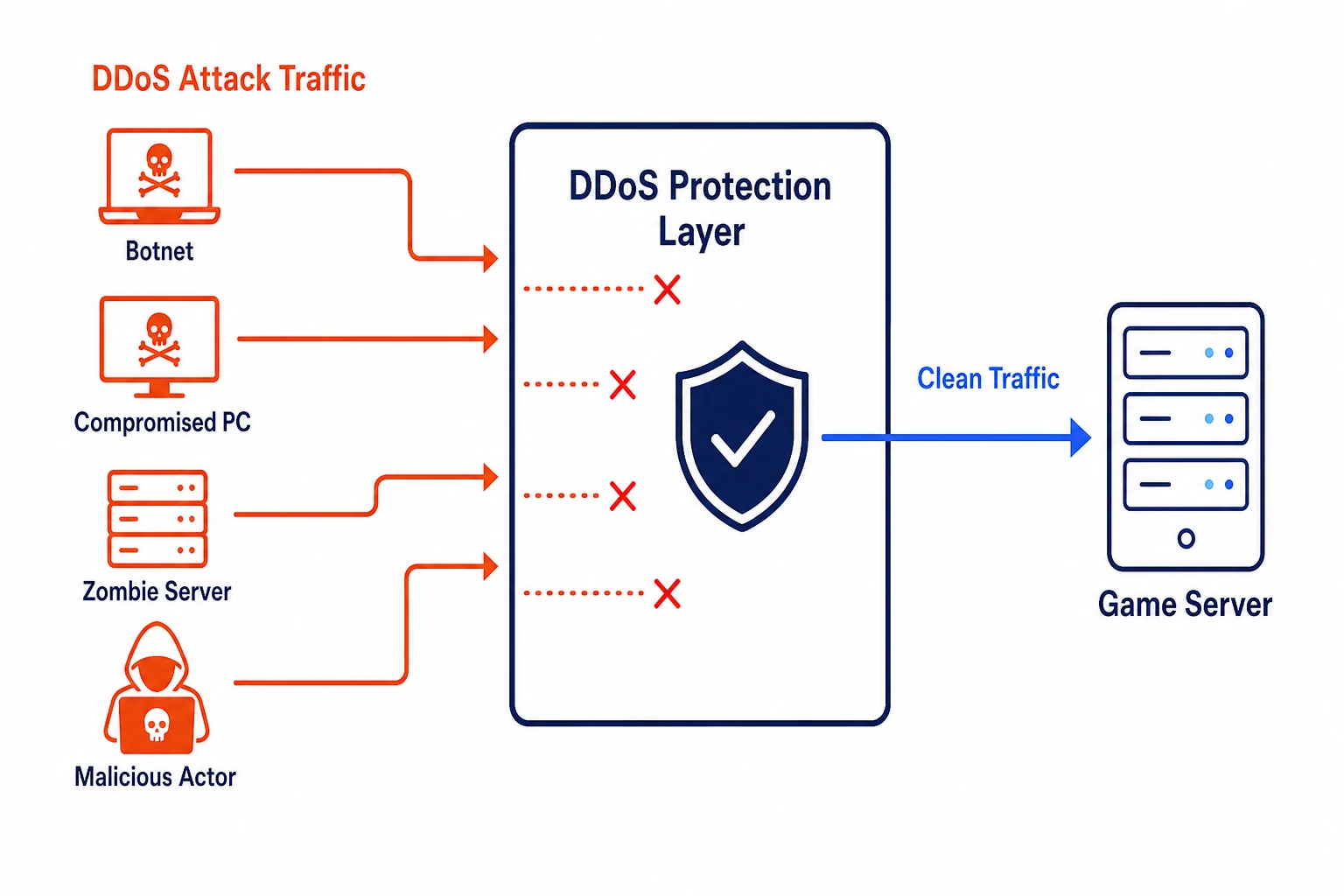
When an attack hits a server hosted on Bloom’s network, the traffic path unfolds like this:
- Attack traffic is directed at Bloom’s IP space from thousands of compromised devices
- BGP Anycast routing directs all inbound traffic through Cloudflare’s global network
- Cloudflare Magic Transit identifies and absorbs the volumetric flood at the network edge before it reaches the data center
- Clean traffic passing through network-layer filtering continues toward Bloom’s infrastructure
- At supported locations, Bloom’s XDP load balancers inspect each packet at the game protocol level
- Attack packets are dropped on the load balancers before the traffic ever reaches your server’s rack
- Legitimate player connections pass through both filtering layers with normal latency
Your server stays online. Players experience no disruption.
For comparison: if the same attack targeted a competitor running standard L3/L4 protection with 200 Gbps of upstream capacity, a 2 Tbps attack saturates the upstream connection. The entire node goes offline. Every server on that physical machine goes down with it. The situation resolves only when the attack stops, which could be minutes or hours.
What to Look for When Evaluating DDoS Protection
If you are choosing a host based on DDoS protection claims, these are the specific questions worth asking before signing up:
- What is the exact mitigation capacity? Get a number in Gbps or Tbps. “Unlimited” is not an answer. No infrastructure has truly unlimited capacity, and any host using that language is substituting marketing copy for a technical specification.
- Is L7 filtering included? Ask specifically whether filtering happens at the application layer and which game protocols are covered. If the answer is vague or the support team cannot answer it, the answer is probably no.
- How is the filtering implemented? Hardware-based inline filtering such as XDP processes packets at line rate without latency penalties. Software-based scrubbing or routing through remote cleaning centers can add meaningful latency.
- Is protection included or an upsell? Some hosts offer basic protection on base plans and charge extra for higher mitigation tiers. Ask specifically whether the plan you are looking at includes full protection or a limited version.
- What happens to other servers on your node during an attack? If one server on your shared node gets attacked and the upstream saturates, does your server go down too? Or does the filtering happen far enough upstream that other servers on the node are not affected?
- How is the protection delivered? Cloudflare Magic Transit, an in-house hardware scrubbing center, and filtering provided by the data center upstream represent very different levels of investment and capability.
The Bottom Line
DDoS attacks against game servers are common and not going away. The tools to launch them are cheap and widely accessible. The motivation to use them — whether from competitive rivalry, player disputes, or simple malice — is always present in gaming communities.
The gap between marketing language and actual protection is wide at most game hosting providers. Basic L3/L4 filtering was adequate five years ago. It is not adequate now. Modern attacks are measured in terabits, and application-layer floods have become a standard attack vector precisely because they bypass network-level filtering entirely.
Effective protection requires both scale and depth: enough capacity to absorb large attacks, and protocol-aware filtering at the application layer. But capacity alone does not tell the whole story. A host can advertise hundreds of gigabits of mitigation and still let attack traffic through if the filtering rules are poorly tuned or the system cannot handle the specific attack vectors targeting game servers. The quality of filtering — how many attack vectors are covered, how accurately legitimate traffic is distinguished from floods, and how quickly new attack patterns are identified — matters as much as the raw capacity number.
Bloom’s approach combines Cloudflare Magic Transit for massive-scale volumetric absorption with purpose-built XDP load balancers for protocol-aware L7 filtering. The combination covers both the scale problem and the precision problem: Cloudflare handles the raw bandwidth, XDP handles the application-layer intelligence. Those two layers working together are what keep a server online during an active attack.
Bloom Host includes both layers on every plan, at every price point, without charging extra. If you are running a server with a real player base, it is worth knowing exactly what your host’s protection actually consists of — not just that “DDoS protection is included.”
Check out Bloom Host’s Minecraft server plans, or review the full DDoS protection details.
Frequently asked questions
What does DDoS stand for and what makes it different from a regular DoS attack?
DDoS stands for Distributed Denial of Service. A standard DoS attack originates from a single source and can be blocked by refusing connections from that IP address. A DDoS attack uses thousands to millions of compromised devices simultaneously, which makes IP-based blocking ineffective.
Will DDoS protection affect my server performance or add latency?
Good DDoS protection has no noticeable impact on latency during normal operation. Cloudflare Magic Transit routes traffic through Cloudflare's Anycast network and forwards clean traffic to the origin with minimal added latency. Since 95% of the world's internet users are within 50ms of a Cloudflare data center, routing through their network can actually improve path efficiency. Bloom's XDP load balancers make filtering decisions in microseconds and drop attack packets before they ever reach your server.
Does DDoS protection prevent all downtime?
No protection system guarantees zero downtime in every scenario. What effective protection does is handle the vast majority of attack scenarios without any server impact. Cloudflare Magic Transit's 400+ Tbps capacity covers the realistic threat landscape for game servers by a significant margin.
What is Cloudflare Magic Transit and how is it different from standard Cloudflare products?
Cloudflare Magic Transit is Cloudflare's network-level DDoS protection product, designed for infrastructure providers and enterprise networks rather than individual websites. It works by announcing your IP ranges via BGP through Cloudflare's global Anycast network, routing all traffic through Cloudflare's scrubbing infrastructure before it reaches your servers.
What is XDP and why does it matter for DDoS protection?
XDP (eXpress Data Path) is a Linux kernel framework that allows packet processing programs to run directly in the network driver, before packets reach the kernel networking stack. For DDoS filtering, this means pass or drop decisions happen at the lowest possible level in the software stack, at line rate with microsecond latency.
What is the difference between L3/L4 and L7 DDoS protection?
Layer 3 and Layer 4 protection filters traffic based on network and transport layer information: IP addresses, ports, TCP flags, packet sizes, and header data. Layer 7 protection operates at the application layer and requires parsing the actual content of packets to evaluate whether they represent legitimate application behavior.
Does DDoS protection apply to VPS and bare metal plans as well as Minecraft hosting?
All Bloom Host plans include DDoS protection, covering Minecraft hosting, VPS hosting, and bare metal dedicated servers. The same Cloudflare Magic Transit coverage applies across all products at all locations.
My previous host's entire network went down when I was attacked. Why does that happen?
When a host's network goes down during an attack targeting a single server, it almost always means the upstream connection was saturated. The attack traffic exceeded the total capacity of the host's upstream link, which is shared across all servers on that node. With Bloom's Cloudflare Magic Transit setup, attack traffic is scrubbed at Cloudflare's global network edge before it ever reaches the data center.
Can an attacker just keep attacking until the protection fails?
With 400+ Tbps of mitigation capacity behind Cloudflare Magic Transit, an attacker would need to sustain an attack larger than the largest attack ever recorded to saturate the protection. Bloom's infrastructure is architected so that the cost to the attacker of sustaining a meaningful attack far exceeds the impact on the server being targeted.